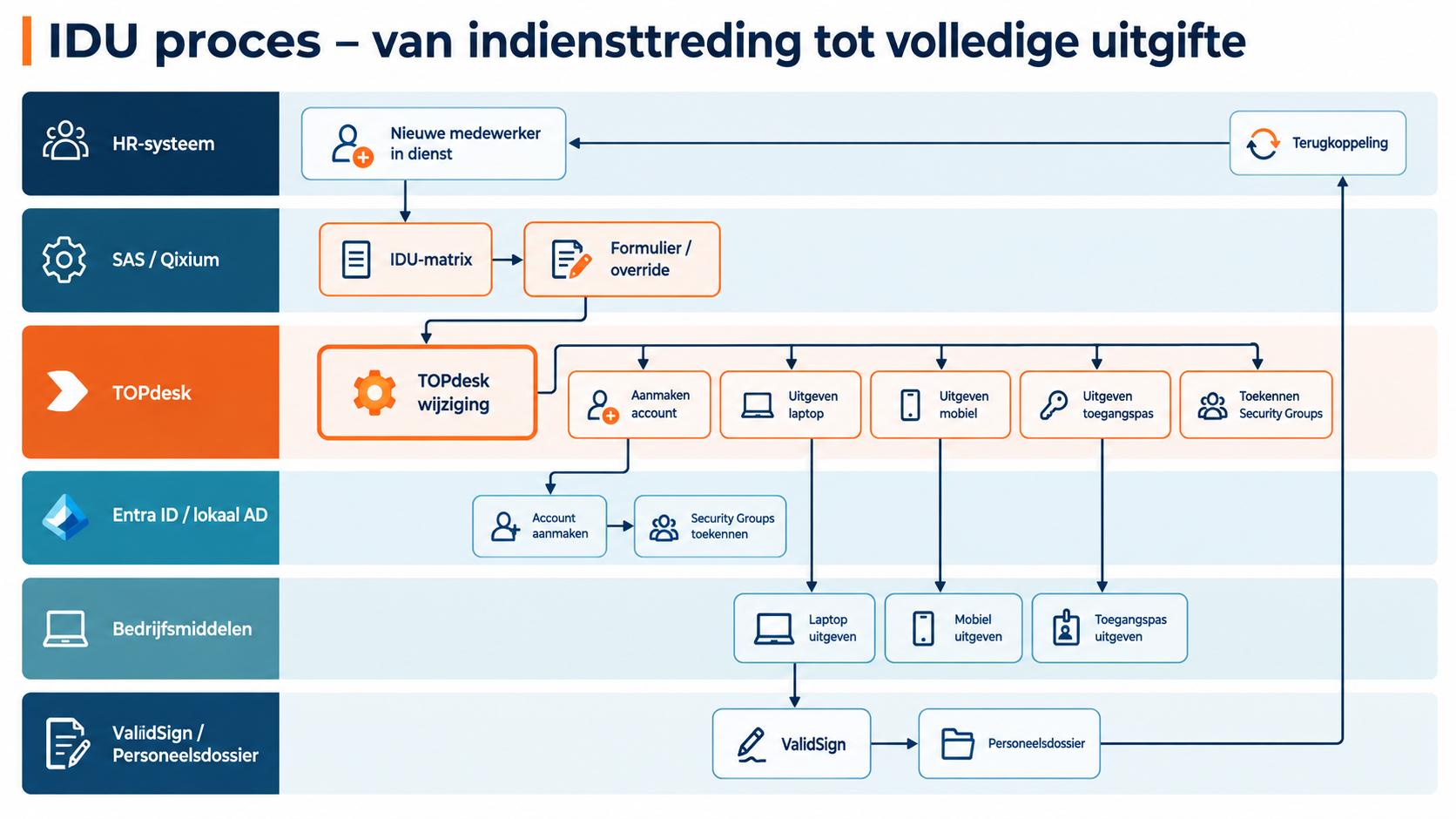
Service Automation Suite connects IAM to the wider employee workflow. Use a matrix in Service Automation Suite to relate roles to access, assets and tasks, for example. Combine those rules with current HR and TOPdesk data and agree who maintains the matrix. This determines the changes and actions needed.
Service Automation Suite · Central coordination
Lifecycle matrix, form & exceptions
Combine the data with your policy, risk assessments and checks. Request information or a decision where needed, track actions and record the outcome.
Use the HR change and current person, access and asset data. Forms or reviews supply missing information and exceptions.
Let the matrix define the route
Service Automation Suite applies role profiles, conditions and effective dates. Start or update the TOPdesk change with appropriate activities for HR, IT and facilities.
Execute, confirm and update
Connect account and group actions to asset handover and confirmation. Include ValidSign signing and file storage where needed. Return outcomes to the activities.
Complete the loop with HR
Once the account is created, write agreed account data or status back to AFAS or the chosen HR source. The TOPdesk activity receives the same outcome. HR and IT no longer need to copy or chase confirmation separately.
View the complete employee lifecycle
Role change
A different role. An appropriate new setup.
Service Automation Suite connects IAM to the wider employee workflow. Use a matrix in Service Automation Suite to relate roles to access, assets and tasks, for example. Combine those rules with current HR and TOPdesk data and agree who maintains the matrix. This determines the changes and actions needed.
Service Automation Suite · Central coordination
Lifecycle matrix, form & exceptions
Combine the data with your policy, risk assessments and checks. Request information or a decision where needed, track actions and record the outcome.
Use the HR change and current person, access and asset data. Forms or reviews supply missing information and exceptions.
Let the matrix define the route
Service Automation Suite applies role profiles, conditions and effective dates. Start or update the TOPdesk change with appropriate activities for HR, IT and facilities.
Execute, confirm and update
Connect account and group actions to asset handover and confirmation. Include ValidSign signing and file storage where needed. Return outcomes to the activities.
Complete the loop with HR
Return confirmed changes or revocations to TOPdesk activities and, where agreed, the HR source. Employee records, execution and follow-up stay aligned.
Offboarding
Departure known. Access and assets follow through.
Service Automation Suite connects IAM to the wider employee workflow. Use a matrix in Service Automation Suite to relate roles to access, assets and tasks, for example. Combine those rules with current HR and TOPdesk data and agree who maintains the matrix. This determines the changes and actions needed.
Service Automation Suite · Central coordination
Lifecycle matrix, form & exceptions
Combine the data with your policy, risk assessments and checks. Request information or a decision where needed, track actions and record the outcome.
Use the HR change and current person, access and asset data. Forms or reviews supply missing information and exceptions.
Let the matrix define the route
Service Automation Suite applies role profiles, conditions and effective dates. Start or update the TOPdesk change with appropriate activities for HR, IT and facilities.
Revoke, recover and complete
Connect revocation of access and groups to asset returns. Update relationships and records, keeping open activities visible until their outcome is known.
Complete the loop with HR
Return confirmed changes or revocations to TOPdesk activities and, where agreed, the HR source. Employee records, execution and follow-up stay aligned.
IAM & auditability
From access decision to demonstrable execution.
A closed ticket does not explain why access was granted or what actually happened. Connect the IAM decision to approval, TOPdesk activities and outcomes from the systems involved. Support auditability and accountability, including within BIO2.
Service Automation Suite · Central coordination
Applied rules, actions & exceptions
Combine the data with your policy, risk assessments and checks. Request information or a decision where needed, track actions and record the outcome.
Connect the person, reason and required approval to the requested access or assets.
Connect activities to actual outcomes
Return system actions and manual confirmations to the TOPdesk change and activities. A sent command does not prove successful execution.
Keep exceptions actionable
Show what was executed, what differs and who must act. This supports controls and reviews; compliance also requires appropriate policies and operations.
Align access
A TOPdesk request. Access follows under control.
Connect an approved request or employee change to accounts, groups and access in Entra ID. Return the outcome or exception to the service ticket.
Service Automation Suite · Central coordination
Combine data and apply rules
Combine the data with your policy, risk assessments and checks. Request information or a decision where needed, track actions and record the outcome.
Choose the authoritative existing record, for example in HR or TOPdesk, and use Service Automation Suite to connect it to the right Microsoft Entra user and groups.
Grant or revoke access
Service Automation Suite can map approved changes to accounts and group memberships through Microsoft Graph. Security controls remain part of your configuration.
Maintain relationships and outcomes
Have Service Automation Suite update agreed person and asset relationships, for example in TOPdesk, and return the result or error to the original request.
Employee lifecycle
One employee change. The right next steps.
Connect onboarding, role changes and departures to access, assets and service tasks. HR remains the source; each team receives its own follow-up.
Service Automation Suite · Central coordination
Combine data and apply rules
Combine the data with your policy, risk assessments and checks. Request information or a decision where needed, track actions and record the outcome.
Choose the request, change or discrepancy that needs follow-up and who decides.
Connect people and systems
Coordinate approvals, manual tasks and available system actions.
Record the result
Record which steps are complete and where someone still needs to act.
How Service Automation Suite connects data and execution
The work between your applications
Change requested. Who handles the next steps?
Service Automation Suite connects Microsoft Entra ID with your other applications, people and rules. Keep data aligned, work moving and outstanding actions visible.
A change, request or alert
Service Automation Suite
Data, people, assets and relationships on one foundation.
Compare
What exists? What should exist?
Determine what is needed
Matrix · policy · legal requirements
Coordinate the next steps
Checks · tasks · approvals · actions
Execution ↔ feedback
Your people and tools
Microsoft Entra ID
For example. Also with other teams, suppliers and applications.
Verify. Inform. Report.
What is complete? Who needs to act? Which exception needs attention?
Start with one integration, register or check. Build on the same data and rules.
Combine into one controlled process
Data → rules → execution
Combine
Employee + current access + equipment
Determine & check
Determine desired state; act after approval
Execute & report back
Update accounts and groups · Start equipment tasks · Report execution
Check sources and rules, test changes and track the outcome. Manual tasks get an owner and confirmation.
Build visually. Manage easily.
Reuse building blocks, adapt your process and test the change. Manage it yourself, together with us or let Scope4mation take care of it.
From product to process
How to use the integration
Approved account changes
Connect approved requests to supported user and group changes.
Join, move & leave
Use employee changes to coordinate agreed account, equipment and service tasks.
Exceptions → tasks
Route missing information or discrepancies to the team responsible for follow-up.
Connect work across your applications
What would you like to connect Microsoft Entra ID with?
Choose the role in your workflow. Explore applications from the scenarios and further directions to discuss together. We define the data, actions and available interface for each combination.
Connect Microsoft Entra ID with your other applications. Automate the work between them and stay in control.
Process & control
Less manual work
Connect Microsoft Entra ID with HR, IT and suppliers. Automate the flow of data and actions.
Control over execution
Define rules, follow up exceptions and verify the outcome.
Purposeful data sharing
Decide which data to share, with whom and under which conditions.
Autonomy & choice
Your applications, one process
Combine Microsoft Entra ID with the applications that fit your organisation.
Direct access to the makers
Work directly with Scope4mation: Dutch technology, process expertise and support in one team.
Room to adapt
Reuse your configuration and keep process knowledge transferable as systems or rules change.
Build & operate together
Start small, build further
Start with one use case and reuse the building blocks for the next.
From idea to practice, together
We help with configuration, exceptions and handover, starting from your daily practice.
Operate it your way
Operate it yourself, together or with us. Agree on clear responsibilities upfront.
Under the hood
This integration, step by step.
How we configure this example
From an approved HR change to the correct Entra account
Connect and retrieve
Connect Microsoft Graph through an app registration in the Entra tenant. Separate user-read permissions from permissions to change accounts or group membership.
Find the correct record
Relate the employee number to the user object ID. Use the UPN to recognise the account but retain the object ID when the sign-in name changes.
Execute the agreed action
Compare desired groups from your role matrix with current membership. Apply only approved additions or removals; handle account creation, blocking and licences as separate actions.
Verify the outcome
Read back the user and relevant groups before completing the HR or service task. Keep rejected group changes open with the account reference and failure reason.
Start with one use case. Connect customer, employee and asset data, for example, and agree which source is authoritative. Reuse those relationships, a matrix where needed and configured actions in the next workflow. Agree who maintains the data and rules. Expand without repeatedly connecting and maintaining the same information.
Signature declined. Keep the process moving.
A request awaits a ValidSign signature. Declining, expiry and technical failure each need different handling.
Combine
Link the request, signing request and document. Read the available status and apply agreed conditions to determine the next action.
The outcome determines what follows
Signed: process the document and confirm the activity. Declined: route the reason to the owner. Temporary technical failure: retry only under the configured error rule.
The benefit
Appropriate follow-up for each outcome without counting a sent signing request as completed work.
A replacement laptop without losing context.
An employee receives a replacement device. The old asset, new record and open service or security tickets must remain connected.
Combine
Use the central relationship between owner and device identifiers. Combine handover, technical inventory and return with existing tickets.
The outcome determines what follows
Receipt confirmed: update ownership and relationships. Old device missing or uncertain match: start a targeted review instead of overwriting historical records.
The benefit
Current records and a traceable handover even when a management tool uses different names.
Temporary access, with the end handled too.
Additional access is approved for a limited period. A checkbox alone does not preserve why, for whom and until when.
Combine
Connect identity, approval, expiry date and the available access action. Reuse the same data for a scheduled follow-up check.
The outcome determines what follows
Revocation confirmed: record the result. Extension requested: ask for a new decision. Not revoked: raise the exception with the authorised group rather than silently completing it.
The benefit
Fewer forgotten exceptions and a traceable relationship between approval and actual access.
Your process needs more than a standard action?
Configure the missing API request, input and output in API Composer. Use its response in the next step and combine it with data tables, forms and automations. Extend the same product and reuse the configured building blocks.
Use Service Automation Suite to update a ticket in TOPdesk, for example, with fields available through its API, such as category, priority, status and support group. For another application, configure its request and field mapping. The outcome determines the next action: confirm, add information or request review, not merely check whether the request arrived.
Need to publish data or let others submit it? Endpoint Composer exposes a configured Service Automation Suite data object with selected methods and security profiles. Other building blocks handle subsequent processing.
From product to workflow
Microsoft Entra ID in your workflow
Pull up a chair. Or join us online.
Over coffee, tea or online: tell us what you are working on.
We can help with the integrations, automation and coordination your process needs, even if your application is not listed yet.