Use employee, organisation and contact data from AFAS, for example, to keep your service platform current. TOPdesk is one example, not the limit. If you use another platform or an external service provider, we configure data exchange around your process and the available API.
Service Automation Suite · Central coordination
Match, relate & map
Add a central register and source-of-truth rules. Check differences, request missing data and determine what gets updated.
Source
People, branches & companies
For example, to
Person and company records
Choose the data and destination
Define which AFAS data is needed where: for example, people and branches for your service desk, or company data for a service provider. Share only the agreed selection.
Match relationships and update selectively
Service Automation Suite connects identifiers and field values. In the TOPdesk example, agreed person and company records are created or updated. For another platform, we define source rules and suitable processing; capabilities vary by API and configuration.
Use that context in your service workflow
Link the right person or organisation to a request, change or supplier ticket, for example. If information is missing or an update is rejected, your configuration determines who reviews it and what follows. Current data becomes the foundation for further automation.
To your other applications
Connect AFAS to what your process needs.
Not every workflow runs through a service desk. Use AFAS data directly for an account in Microsoft Entra, for example, or update contact and company data in another business application. The destination, data and direction depend on your goal.
Service Automation Suite combines source information with your rules and reusable mapping tables.
Service Automation Suite · Central coordination
Match, validate and map
Add a central register and source-of-truth rules. Check differences, request missing data and determine what gets updated.
Choose AFAS as the source for name, department and employment data, for example. Define which fields the destination owns. An integration need not copy everything or automatically work in both directions.
Combine data with your own rules
Use a central matching table or an account-profile matrix, for example. Check existing records before creating or changing anything. If a reliable match is missing, request information or review first.
Verify the outcome and build further
Execute the available API action and check the response. Confirmed account creation can trigger a next step or be written back to HR, for example. For a complete IAM workflow, combine this with approvals, assets, changes and feedback.
Back to AFAS Popular
Return the outcome to AFAS too.
AFAS can supply data and receive outcomes. Have a completed workflow step update agreed data in AFAS. This is a separate route, not an automatic reversal of every sync.
Service Automation Suite · Central coordination
Check & map the outcome
Add a central register and source-of-truth rules. Check differences, request missing data and determine what gets updated.
Execution
Completed activity or workflow status
Update
Agreed fields or records
Identify confirmed execution
Use the confirmed completion of an activity, such as account creation. The outcome, not merely the command, triggers feedback.
Define what AFAS should receive
Service Automation Suite applies matching, mapping and processing rules. Only selected data is written back.
Update and record the outcome
Process through the available AFAS interface and link success or failure to the original workflow.
Time entries to AFAS Popular
Service work in TOPdesk. Processing in AFAS.
Connect time recorded on tickets, changes and activities to the right customer or project in AFAS. Current person and company data provides the foundation.
Service Automation Suite · Central coordination
Match customer, project & processing
Add a central register and source-of-truth rules. Check differences, request missing data and determine what gets updated.
Source
Time entries & service work
Update
Time accounting or invoicing
Collect service time
Use agreed time records and their related person, organisation and work.
Match customer and project
Match the sales relationship and project in AFAS. Route missing data for review.
Process after the agreed review
Connect data to time accounting or invoicing. Finance retains review responsibility; the workflow receives the outcome.
IAM with AFAS · onboarding
From employee change to a complete start.
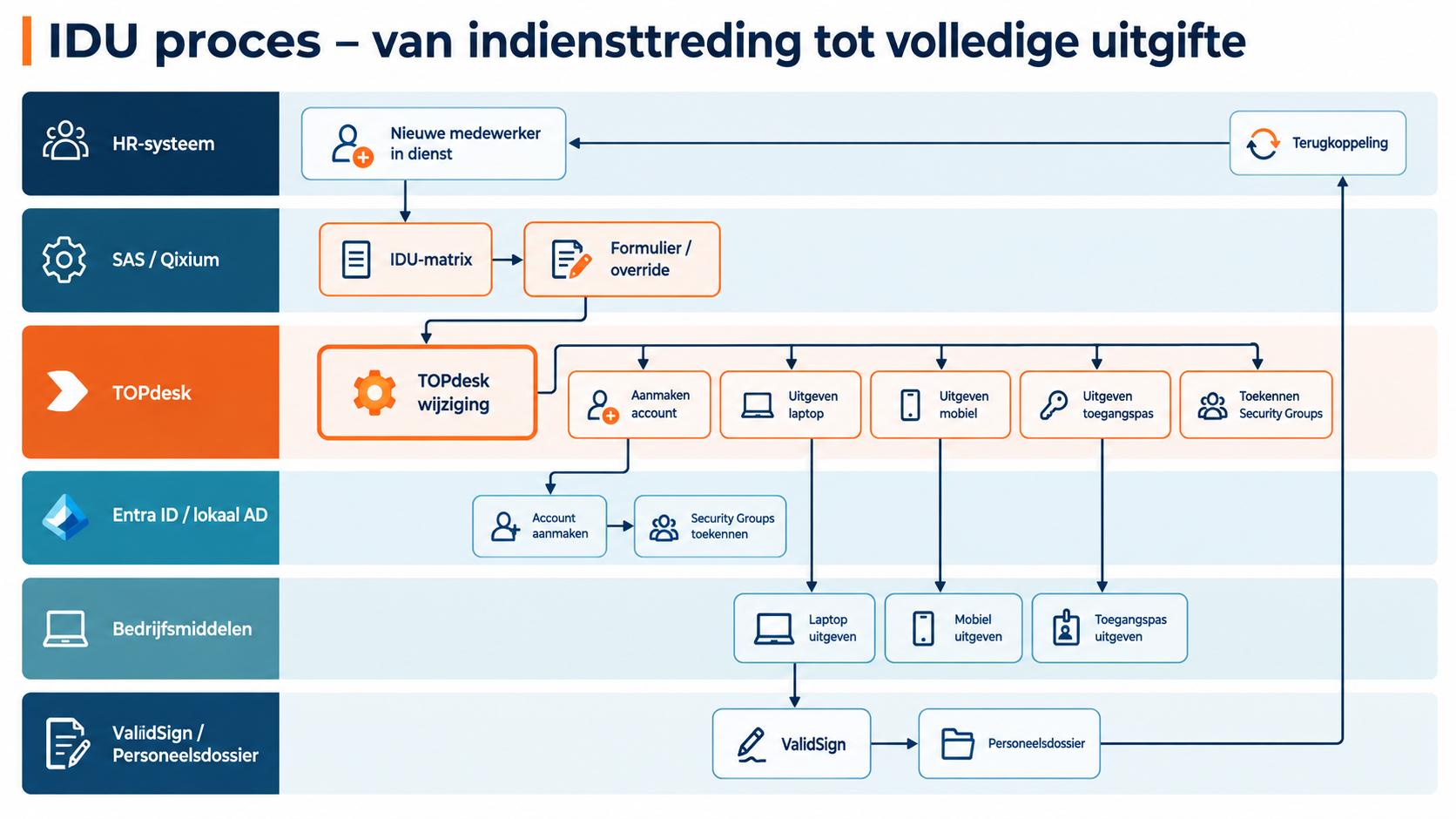
Service Automation Suite connects IAM to the wider employee workflow. Use a matrix in Service Automation Suite to relate roles to access, assets and tasks, for example. Combine those rules with current HR and TOPdesk data and agree who maintains the matrix. This determines the changes and actions needed.
Service Automation Suite · Central coordination
Lifecycle matrix, form & exceptions
Combine the data with your policy, risk assessments and checks. Request information or a decision where needed, track actions and record the outcome.
Use the HR change and current person, access and asset data. Forms or reviews supply missing information and exceptions.
Let the matrix define the route
Service Automation Suite applies role profiles, conditions and effective dates. Start or update the TOPdesk change with appropriate activities for HR, IT and facilities.
Execute, confirm and update
Connect account and group actions to asset handover and confirmation. Include ValidSign signing and file storage where needed. Return outcomes to the activities.
Complete the loop with HR
Once the account is created, write agreed account data or status back to AFAS or the chosen HR source. The TOPdesk activity receives the same outcome. HR and IT no longer need to copy or chase confirmation separately.
View the complete employee lifecycle
IAM · role changes
A different role. An appropriate new setup.
Service Automation Suite connects IAM to the wider employee workflow. Use a matrix in Service Automation Suite to relate roles to access, assets and tasks, for example. Combine those rules with current HR and TOPdesk data and agree who maintains the matrix. This determines the changes and actions needed.
Service Automation Suite · Central coordination
Lifecycle matrix, form & exceptions
Combine the data with your policy, risk assessments and checks. Request information or a decision where needed, track actions and record the outcome.
Use the HR change and current person, access and asset data. Forms or reviews supply missing information and exceptions.
Let the matrix define the route
Service Automation Suite applies role profiles, conditions and effective dates. Start or update the TOPdesk change with appropriate activities for HR, IT and facilities.
Execute, confirm and update
Connect account and group actions to asset handover and confirmation. Include ValidSign signing and file storage where needed. Return outcomes to the activities.
Complete the loop with HR
Return confirmed changes or revocations to TOPdesk activities and, where agreed, the HR source. Employee records, execution and follow-up stay aligned.
IAM · offboarding
Departure known. Access and assets follow through.
Service Automation Suite connects IAM to the wider employee workflow. Use a matrix in Service Automation Suite to relate roles to access, assets and tasks, for example. Combine those rules with current HR and TOPdesk data and agree who maintains the matrix. This determines the changes and actions needed.
Service Automation Suite · Central coordination
Lifecycle matrix, form & exceptions
Combine the data with your policy, risk assessments and checks. Request information or a decision where needed, track actions and record the outcome.
Use the HR change and current person, access and asset data. Forms or reviews supply missing information and exceptions.
Let the matrix define the route
Service Automation Suite applies role profiles, conditions and effective dates. Start or update the TOPdesk change with appropriate activities for HR, IT and facilities.
Revoke, recover and complete
Connect revocation of access and groups to asset returns. Update relationships and records, keeping open activities visible until their outcome is known.
Complete the loop with HR
Return confirmed changes or revocations to TOPdesk activities and, where agreed, the HR source. Employee records, execution and follow-up stay aligned.
IAM & auditability
From access decision to demonstrable execution.
A closed ticket does not explain why access was granted or what actually happened. Connect the IAM decision to approval, TOPdesk activities and outcomes from the systems involved. Support auditability and accountability, including within BIO2.
Service Automation Suite · Central coordination
Applied rules, actions & exceptions
Combine the data with your policy, risk assessments and checks. Request information or a decision where needed, track actions and record the outcome.
Connect the person, reason and required approval to the requested access or assets.
Connect activities to actual outcomes
Return system actions and manual confirmations to the TOPdesk change and activities. A sent command does not prove successful execution.
Keep exceptions actionable
Show what was executed, what differs and who must act. This supports controls and reviews; compliance also requires appropriate policies and operations.
Sign for equipment
Equipment handed over. Receipt confirmed.
An employee joins or changes roles. Connect the HR change to a laptop or phone handover and request digital confirmation of receipt, for example through ValidSign. Service Automation Suite brings the employee, asset, document and follow-up together. Configuration follows your rules and the available interfaces.
Service Automation Suite · Central coordination
Connect assignment, handover and signing
Combine the data with your policy, risk assessments and checks. Request information or a decision where needed, track actions and record the outcome.
Start with the employee
Onboarding or role change and agreed equipment
Confirmation & records
For example, digital signing and evidence linked to the asset
Define the equipment handover
Use employee and role data from the chosen HR source. Check the assigned equipment, required approval and handover owner. Link employee and asset to the same request or activity.
Request confirmation of receipt
Prepare a receipt or equipment loan declaration with the correct employee and asset data according to your rules. Start a signing request in ValidSign, for example, and track the available signing status. Sending a request does not mean receipt has been confirmed.
Store evidence and follow up exceptions
After confirmed signing, store the document or its reference with the correct asset and record, for example in TOPdesk. Assign an owner to declined or expired requests and missing data. Configure feedback to HR only where available and agreed.
How Service Automation Suite connects data and execution
The work between your applications
HR updated. Everything else too?
Service Automation Suite connects AFAS with your other applications, people and rules. Keep data aligned, work moving and outstanding actions visible.
A change, request or alert
Service Automation Suite
Data, people, assets and relationships on one foundation.
Compare
What exists? What should exist?
Determine what is needed
Matrix · policy · legal requirements
Coordinate the next steps
Checks · tasks · approvals · actions
Execution ↔ feedback
Your people and tools
Microsoft Entra ID
For example. Also with other teams, suppliers and applications.
Verify. Inform. Report.
What is complete? Who needs to act? Which exception needs attention?
Start with one integration, register or check. Build on the same data and rules.
Combine into one controlled process
Data → rules → execution
Combine
HR + role + start date
Determine & check
Determine profile, check and approve
Execute & report back
Entra: account and groups · TOPdesk: laptop handover · Welcome task: arrange flowers
View the complete onboarding example
Check sources and rules, test changes and track the outcome. Manual tasks get an owner and confirmation.
Build visually. Manage easily.
Reuse building blocks, adapt your process and test the change. Manage it yourself, together with us or let Scope4mation take care of it.
From product to process
How to use the integration
Join, move & leave
Use employee changes to coordinate agreed account, equipment and service tasks.
Keep people records current
Synchronise agreed person and organisation fields between the relevant applications.
Handover & return
Connect staff changes to equipment handover and confirmed return.
Connect work across your applications
What would you like to connect AFAS with?
Choose the role in your workflow. Explore applications from the scenarios and further directions to discuss together. We define the data, actions and available interface for each combination.
Start with one use case. Connect customer, employee and asset data, for example, and agree which source is authoritative. Reuse those relationships, a matrix where needed and configured actions in the next workflow. Agree who maintains the data and rules. Expand without repeatedly connecting and maintaining the same information.
Signature declined. Keep the process moving.
A request awaits a ValidSign signature. Declining, expiry and technical failure each need different handling.
Combine
Link the request, signing request and document. Read the available status and apply agreed conditions to determine the next action.
The outcome determines what follows
Signed: process the document and confirm the activity. Declined: route the reason to the owner. Temporary technical failure: retry only under the configured error rule.
The benefit
Appropriate follow-up for each outcome without counting a sent signing request as completed work.
Temporary access, with the end handled too.
Additional access is approved for a limited period. A checkbox alone does not preserve why, for whom and until when.
Combine
Connect identity, approval, expiry date and the available access action. Reuse the same data for a scheduled follow-up check.
The outcome determines what follows
Revocation confirmed: record the result. Extension requested: ask for a new decision. Not revoked: raise the exception with the authorised group rather than silently completing it.
The benefit
Fewer forgotten exceptions and a traceable relationship between approval and actual access.
A different name does not mean a new record.
A person or organisation has a different name in the source than at a customer or supplier. Matching text again can create incorrect or duplicate relationships.
Combine
Retain verified identifiers and source rules in a shared table. Reuse the relationship for requests, tickets and other integrations.
The outcome determines what follows
Known key: use the relationship. Multiple candidates or a missing identifier: request review. Once confirmed, reuse the established relationship.
The benefit
A consistent data foundation managed by your team instead of investigated again for every connection.
Your process needs more than a standard action?
Configure the missing API request, input and output in API Composer. Use its response in the next step and combine it with data tables, forms and automations. Extend the same product and reuse the configured building blocks.
Use Service Automation Suite to update a ticket in TOPdesk, for example, with fields available through its API, such as category, priority, status and support group. For another application, configure its request and field mapping. The outcome determines the next action: confirm, add information or request review, not merely check whether the request arrived.
Need to publish data or let others submit it? Endpoint Composer exposes a configured Service Automation Suite data object with selected methods and security profiles. Other building blocks handle subsequent processing.
From product to workflow
AFAS in your workflow
Pull up a chair. Or join us online.
Over coffee, tea or online: tell us what you are working on.
We can help with the integrations, automation and coordination your process needs, even if your application is not listed yet.