An alert is not the same as follow-up
Flagging an expiring contract is one step. Connect the alert to an owner, a decision and a visible outcome.

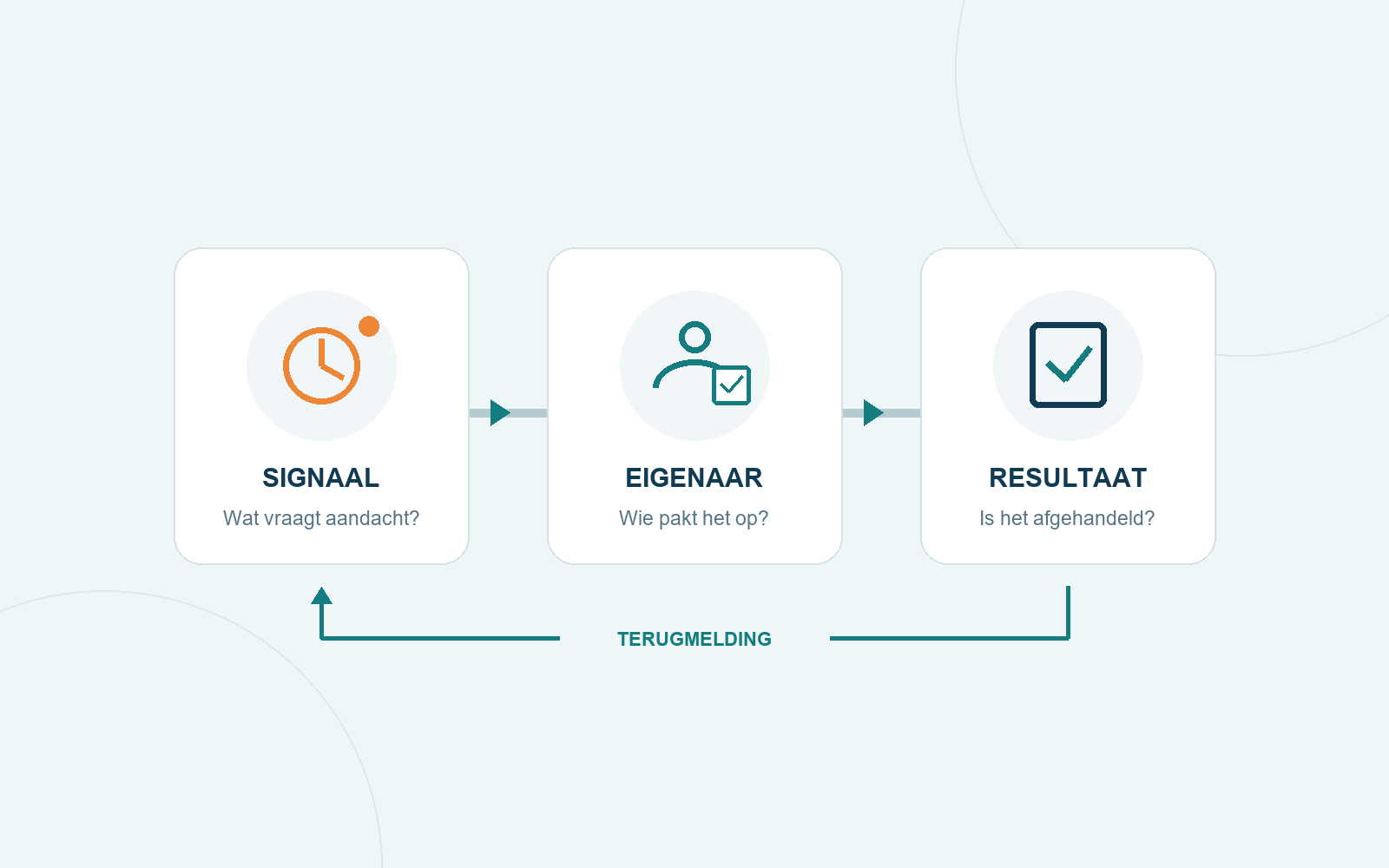
A contract is approaching its end date. A reminder goes out. But who decides whether to renew it, who carries out the change and who checks that it is complete? This is where process control starts.
An alert does not complete the work
An email or dashboard can highlight something that needs attention. Without agreed follow-up, people still need to gather information, find the right colleague and chase progress. The alert has been sent, but the outcome remains uncertain.
The useful question is: what should happen next, and how will the result return to the original record?
Example: a contract expires in 60 days
Suppose you want to review a contract 60 days before its end date. That is an agreed working practice, rather than a fixed product default. A practical process could look like this:
- Check the source. Is the end date current and is the contract owner known? Missing information first goes to someone who can complete it.
- Assign the review. The contract owner receives the relevant information and a request to renew, change or terminate the contract.
- Record the decision. Add approval where needed. A reminder is not permission to renew automatically.
- Carry out the agreed action. For example, create a task for procurement or operations. Make sure the same review is not repeatedly created as new work.
- Report the outcome. Record what was done, by whom and when. If an action fails, make it clear who will handle recovery.
The role of Service Automation Suite
Service Automation Suite connects data, working agreements and actions across applications. This lets you make alerts part of a process with checks, human tasks and feedback. You define the source, decision-makers and route; for each use case, we agree which integrations and actions are needed and available.
Not every step needs to be automated. A colleague can retain the substantive decision while information gathering and handovers are configured. The value is a connected way of working that your team can follow and manage.
Start with one alert that currently gets stuck
Choose a familiar situation and agree what successful completion looks like. For example, measure how many actions have no owner, how often follow-up is late and how often someone needs to chase an update. That lets you assess the value in your own organisation.
Which alert gets attention in your organisation, but still lacks consistent follow-up? We would be happy to help identify a manageable first step.
More from the same context.

More customers without a proportional increase in administration | Service Automation Suite for MSPs
More customers without a proportional increase in administration: the challenge for MSPs Growth is good news for an MSP. More customers, more services and more recurring revenue. But growth also has its downside: every new customer brings new users, systems, processes and exceptions with it.
17 Sep 2026
Better control over municipal processes
Why municipal processes are increasingly demanding central orchestration A municipality uses many different applications. For citizen services, the social domain, [...]
16 Sep 2026
Does your automation depend on a single administrator?
What happens to your automation if that one administrator leaves? Almost every IT department has one. The administrator [...]
15 Sep 2026
A change of role: do access rights change too?
An employee changes roles. Do access rights change too? An employee moves from Finance to Sales. The new account does not need to be created, as it already exists. The new permissions are requested and, after a short period, the employee can start working.
25 Aug 2026