ESB, iPaaS and IAM: where does your integration need belong?
An ESB or service bus, iPaaS and IAM each have a distinct role. Explore how Service Automation Suite connects systems, data and processes while keeping responsibilities clear.
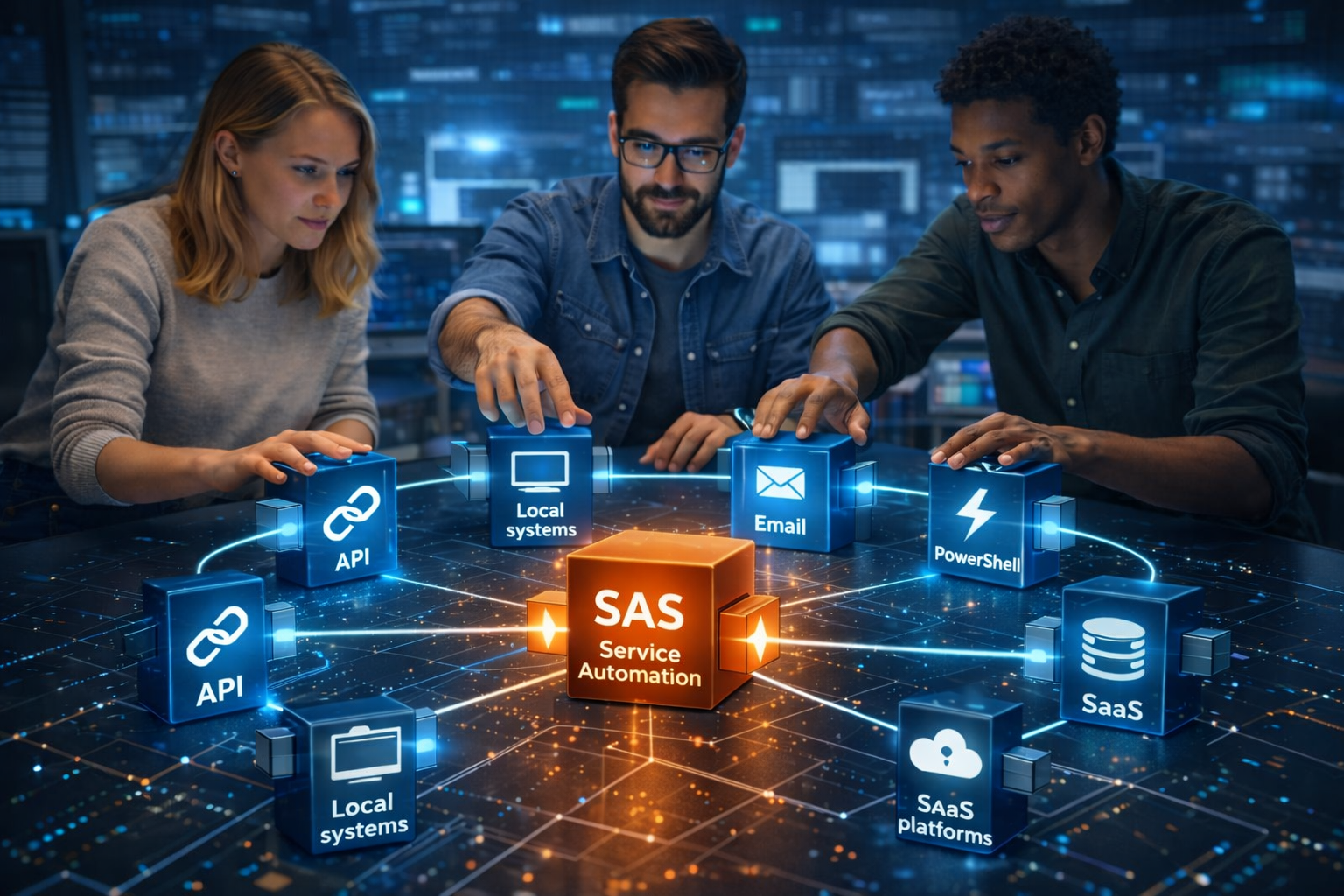
Looking for an ESB, service bus or integration platform? Start with the work you want to connect. A personnel change can affect accounts and permissions, but also a business application, a supplier task or a data check. These steps involve different responsibilities. With Service Automation Suite, we consider the whole process together and the role of each integration.
IAM, iPaaS and ESB: what is the difference?
| Term | What does it address? |
|---|---|
| IAM — Identity & Access Management | Identities, accounts and access rights: who may use which application or information? |
| iPaaS — Integration Platform as a Service | A platform service for connecting applications, data and processing steps and managing integrations. |
| ESB — Enterprise Service Bus | An integration architecture with a central middleware layer for communication between systems, for example message routing and data transformation. Also called a service bus. |
These terms describe different perspectives. An IAM solution can use integrations, and an integration platform can support IAM processes. An ESB is not simply another name for every iPaaS. Capabilities can complement or overlap; your intended architecture determines what you need.
An integration platform for more than identities
Service Automation Suite goes beyond IAM. Our platform approach connects existing applications, data and actions. Think of API integration, data exchange, data synchronisation and process automation across departments and suppliers. We connect to available interfaces and agree which data and actions each integration requires.
System integration is also called application integration or Enterprise Application Integration (EAI). Sometimes the focus is data integration: retrieving, mapping, transforming, validating and feeding data back. Sometimes it is the next action: starting a task, requesting approval or processing an outcome in another system. Together, we determine which Service Automation Suite components fit and are available.
From a connection to a working process
- Employee process: an HR change triggers agreed actions for accounts, permissions, licences and assets. Identity management and asset issuance retain their distinct responsibilities.
- Service process: a request from a service management system receives context from other business applications. The responsible teams retain ownership of assessment and execution.
- Data quality: records from multiple systems are compared. Differences become visible and receive an agreed follow-up; a difference does not automatically authorise changing source data.
Process orchestration concerns the relationship between steps. Which step may start, who assesses an exception and how is the outcome returned? Processing frequency, available triggers and recovery are defined per use case. The general-purpose Process Orchestrator is being developed; existing integrations and automations have their own capabilities.
Where is the architecture boundary?
Provisioning accounts is different from enriching or correcting business data. Even when one platform supports both, responsibilities should remain clear. We therefore discuss:
- Sources and ownership: which system is authoritative for each data item and who owns its meaning and quality?
- Processing: which mapping, validation rules and transformations have been agreed? May enrichment go only to the target system, or back to the source too?
- Execution and recovery: who manages the integration, handles errors, checks changes and approves reprocessing?
- Access and insight: which data is required, who may use it and which logging or feedback is appropriate?
This aligns the service description, technical configuration and operating agreements. Together, we clarify what the platform does and what remains with the connected systems and teams.
Can Service Automation Suite replace a service bus?
We investigate that together. Sometimes overlapping integrations can be consolidated. Sometimes connecting to an existing ESB, iPaaS or other middleware is the right choice. We assess interfaces and protocols, volumes, availability, error handling, operations and existing investments. A comparison starts with those requirements, not a product label.
Our team helps define your integration needs and choose a concrete first use case. This shows how data exchange, automation and process control can work together in your organisation.
Start today. Modernize at your own pace.
You have already invested in systems, integrations and knowledge. With Service Automation Suite, we build on that foundation. Together, we start with one specific integration, manual task or process improvement.
Your existing service bus can keep doing what it does well. We add new connections and automations where they help. Step by step, this creates room to improve or replace components when the time is right for your organization.
Your process determines the route and the pace.
Build on existing investments — connect to what works.
Achieve focused results — start with a specific bottleneck.
Build freedom of choice — reduce dependencies step by step.
Explore the platform FAQ · Explore platform components · Explore integrations · Discuss your integration architecture
Terminology background: Enterprise Service Bus and Integration Platform as a Service. We determine the appropriate configuration and scope together.
More from the same context.

A general-purpose iPaaS platform | Manage integrations intelligently
A general-purpose iPaaS platform only becomes valuable when you gain control over the integration chain. Increasingly, organisations are working with a landscape of SaaS solutions, cloud platforms, legacy applications, and specialised systems. That landscape is constantly evolving.
6 Oct 2026
Intune manages your devices. But who oversees the processes around them?
Microsoft Intune helps organisations manage laptops, mobile devices, configurations, and security policies from a central location. This gives you strong visibility into [...]
21 Sep 2026
Different laptop names in TOPdesk and Intune? Connect the right device.
Connect asset records and managed devices without duplicate administration. Understand identifiers, naming and controlled follow-up.

Joiners, movers and leavers: control over access rights and assets with every personnel change
Joiners, movers and leavers: control over access rights and assets with every personnel change. A new employee joins. HR records their details, accounts […]
24 Sep 2026Recognize this in your organization?
Discuss your process, scenario or control chain with us. You do not need to know the answer yet.